AeroSight FDM v2 integrates with SafeJets in both directions
October 8, 2026 | Product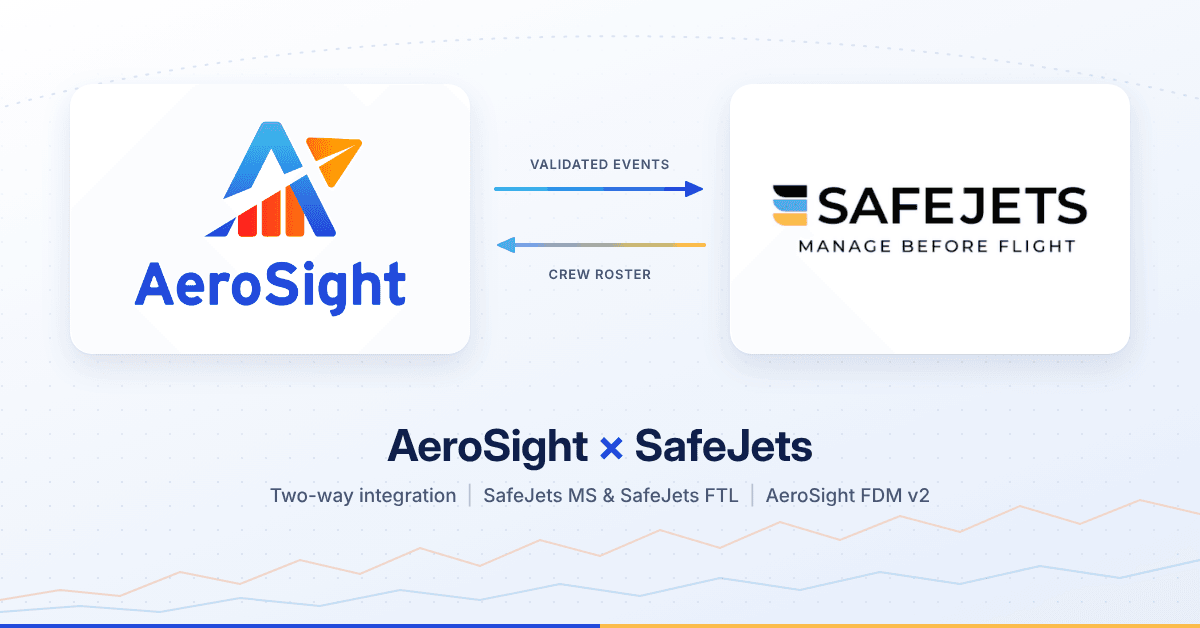
AeroSight Team
Flight data monitoring and safety management have long sat in separate systems, with the gap filled by hand. For operators who use SafeJets, a two-way integration with AeroSight FDM v2 now closes it: accepted events go to SafeJets MS, and performed legs from SafeJets FTL feed Pilot Performance.
Sofia, Bulgaria, 8 October 2026. AeroSight, the flight data monitoring provider, today announced a two-way integration with SafeJets, covering both SafeJets MS, its safety management system, and SafeJets FTL, its crew planning system.
Flight data monitoring and safety management have long sat in separate systems, and the gap between them is filled by hand. An analyst validates an event in the FDM platform, then re-enters it in the safety system so it can be risk-assessed and tracked. The re-entry costs time, and what does not get re-entered does not get managed.
For operators who use SafeJets, the integration closes that gap in both directions.
Accepted events, delivered to SafeJets MS
Once a flight data analyst has validated an event in AeroSight, it is delivered into the operator's SafeJets MS automatically, with its flight context attached. Delivery status is shown on every event in AeroSight, so the safety manager can see what has reached the safety system and what has not, rather than assuming. Nothing is sent before a person has accepted it: the decision to promote a detection into a safety finding stays with the analyst.
Crew planning in SafeJets FTL, feeding pilot performance
In the other direction, AeroSight reads performed legs from SafeJets FTL, so the platform knows which crew flew which sector without anyone maintaining a second roster. That assignment is what makes per-pilot analysis possible in the AeroSight Pilot Performance module, where a pilot's own trend is read against their own history rather than against a colleague's.
The de-identification rules the operator's FDM programme sets are left unchanged, and access follows the named access its information security policy requires: a pilot given access sees their own performance and not a colleague's, and the linking of a platform login to a crew record is the operator's decision, not AeroSight's.
Available with AeroSight FDM v2
The integration is available to operators running AeroSight FDM v2 and holding SafeJets MS, SafeJets FTL or both. Configuration is done once, per operator, and needs no work from the analyst afterwards. SafeJets joins the other systems AeroSight already connects to, listed on the integrations page.
An FDM programme earns its place when a finding changes something. The distance between the analyst who validates an event and the safety manager who has to act on it is where programmes lose their value, and for most operators that distance is a spreadsheet and a retyping job. Connecting the two systems removes it.
Milko Lorinkov, Chief Executive Officer, AeroSight
Collecting data in one place is only the beginning. The real value comes when connected data is transformed into information, knowledge and, ultimately, better operational decisions. By integrating SAFEJETS with AeroSight, we are helping operators bridge the gap between flight data, safety management and crew operations, so that insights can lead more directly to meaningful safety action.
Dr. Tevfik Uyar, CEO, SAFEJETS
About AeroSight
AeroSight is a cloud-based flight data monitoring platform for aircraft operators, built around their operations and company procedures. AeroSight FDM v2, released on 5 October 2026, brings every flight an operator's fleet flies into one platform: recorder data beside ADS-B flight history and near-live fleet monitoring, with weather, published procedures and, where connected, the crew roster linked to each flight. Operators define their own event detection, where every change can be signed off by a second person, and track programme health with KPIs aligned to the EASA EOFDM working group's indicators. Fuel Efficiency, engine condition monitoring and Pilot Performance work from the same recorder data.
Founded in 2016, AeroSight has supported flight data monitoring programmes across 40+ aircraft types for 100+ operators, processes 40,000 flights a month, and has processed more than 1.5 million flights in total. The company is certified to ISO 9001:2015 and ISO 27001:2022 and is a member of the Bulgarian Aviation Industry Association.
About SafeJets
SAFEJETS, founded in 2018, is a leading provider of aviation safety, compliance and operational management software, with a dominant position in Turkey’s business aviation market. Its integrated product suite includes SAFEJETS MS for safety and compliance management and SAFEJETS FTL for flight and duty time management, alongside aviation training and AI-supported safety solutions. Today, SAFEJETS products are used by more than 50 aviation companies operating over 150 aircraft. Building on its strong market leadership in Turkey, SAFEJETS is expanding its international footprint as a globally oriented aviation technology company, serving operators across multiple markets and supporting increasingly connected, data-driven safety and operational management.
Media contact
AeroSight Ltd., Landmark Airport Centre, 10 Prodan Tarakchiev Str., 1528 Sofia, Bulgaria. team@aero-sight.com, +359 889 308 615.
Related Articles
Your FDM programme's health, on the dashboard
AeroSight v2 deep-dive: the EOFDM programme-health KPIs an auditor looks for, reports you build yourself, an Event Definition Sheet with its full sign-off history, and an audit trail of who did what and who could.
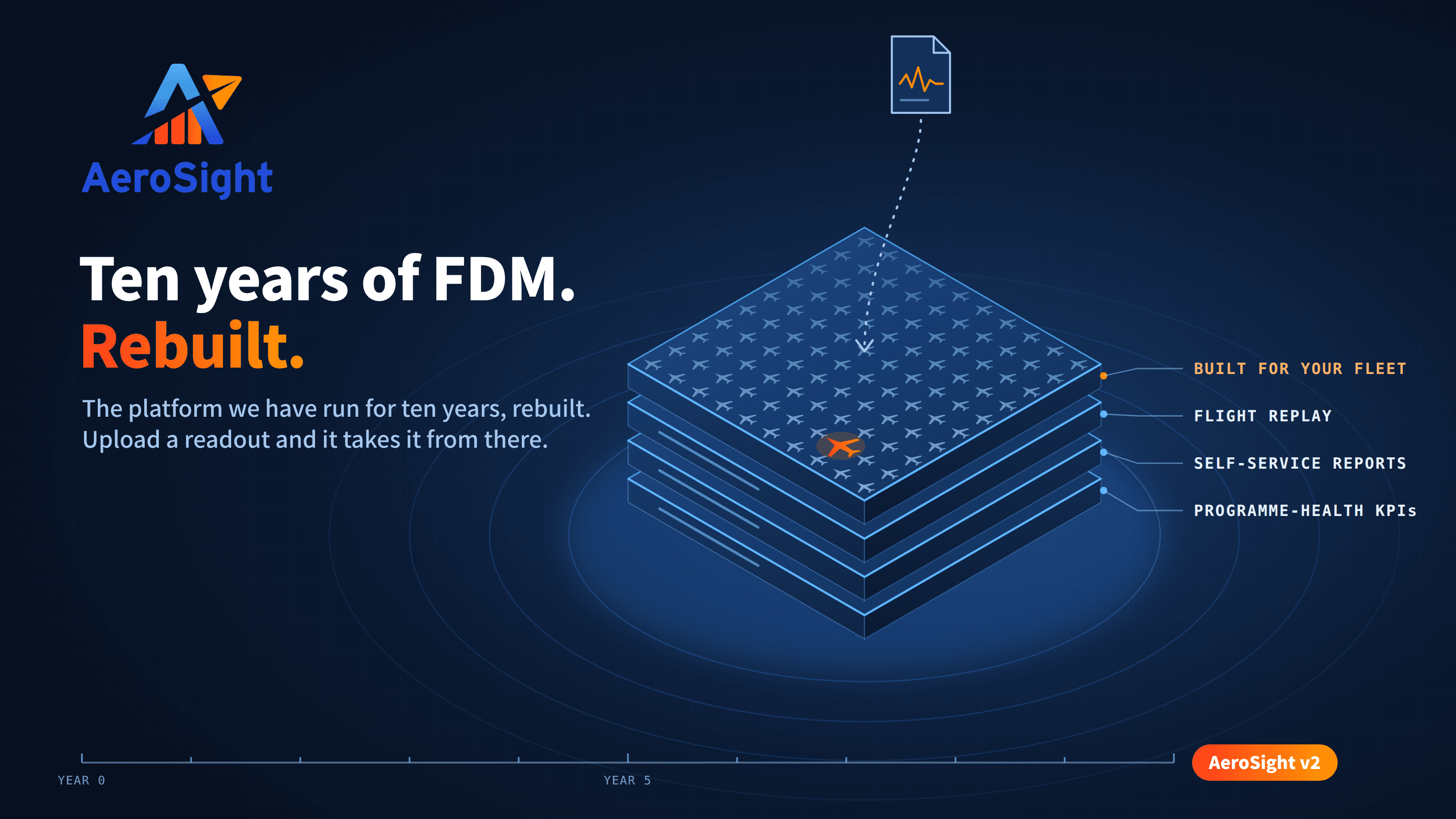
Introducing AeroSight FDM v2 - what ten years taught us
AeroSight FDM v2 is a rebuild of the platform we have run for ten years: every flight your fleet flies, event detection you tune yourself, programme-health KPIs, self-service reports, fuel efficiency and Live Fleet Monitoring, for one aircraft or a hundred.
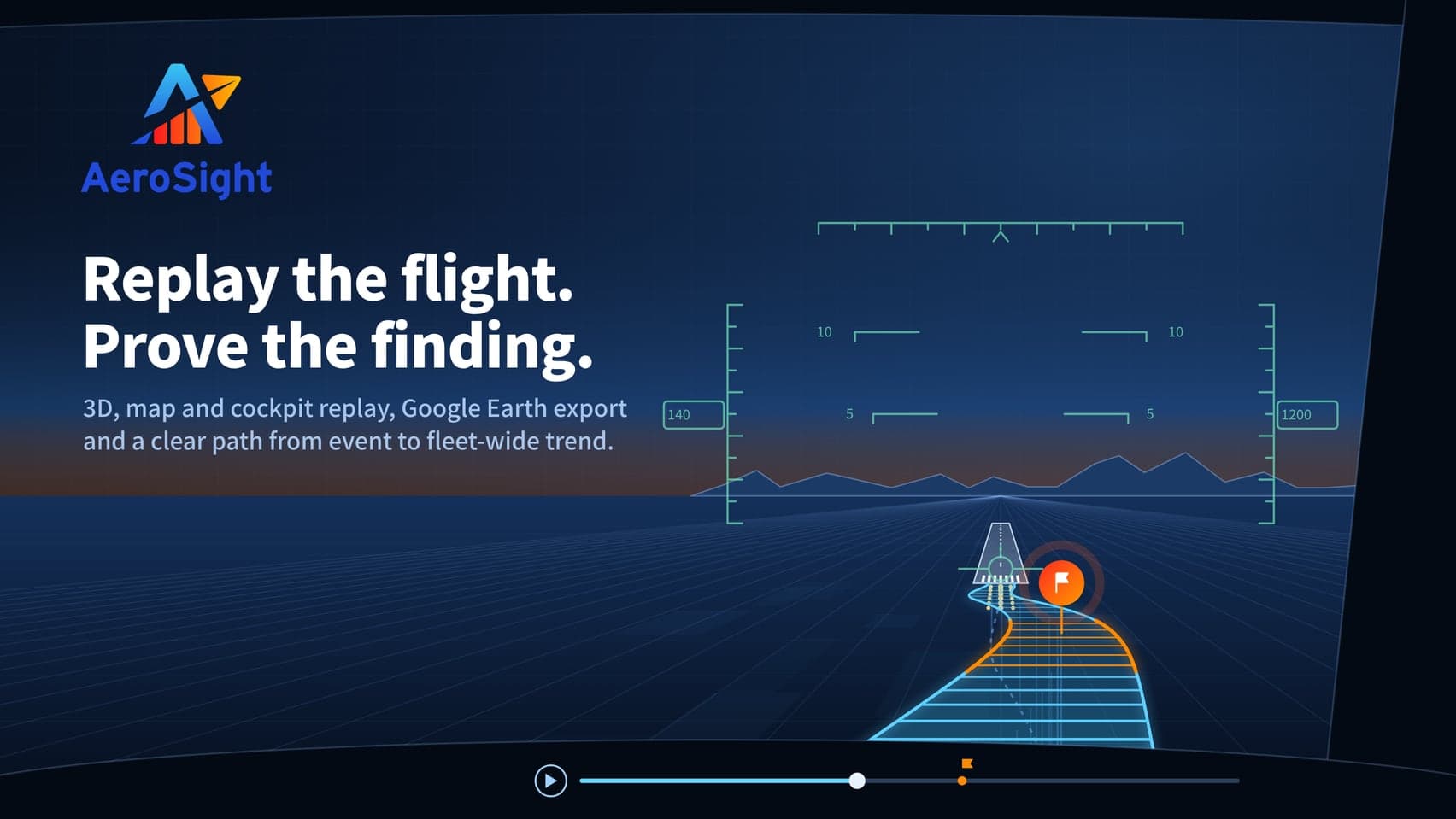
See the flight, not the spreadsheet
The second AeroSight v2 deep-dive: each flight with the weather it was flown in and the published procedure beside its track, three replay views, and one event followed from detection to a fleet-wide trend.