Your FDM programme's health, on the dashboard
October 8, 2026 | Product
AeroSight Team
An FDM programme is easy to start and hard to prove. AeroSight v2 keeps the evidence as you work: collection rate, time to first detection and events per 100 legs on the dashboard, self-service reports, second-person sign-off on the Event Definition Sheet, and an exportable audit trail.
An FDM programme is easy to start on paper and hard to prove effective. The recorders fill up, the downloads arrive, the events get reviewed — and then an auditor sits down across the table and asks a different question. Not "do you have an FDM programme?" but "show me it is working."
That question has a shape. Under Regulation (EU) 965/2012, ORO.AOC.130 and its AMC, and under the equivalent requirements of other authorities, the auditor wants to see that you collect the data you should, find what matters in it promptly, feed what you find back into operations, and control who can change what along the way.
AeroSight v2 was built so that the evidence for each of those is kept as you work.
The KPIs an auditor looks for
The European Operators Flight Data Monitoring forum (EOFDM), hosted by EASA, published guidance through its Working Group C on how to measure whether an FDM programme is effective, not merely present. Three of its indicators go to the heart of what an auditor is trying to establish:
Data collection rate — of the legs you flew, how many came back as usable flight data. Gaps here are the first thing an auditor probes, because every leg you did not collect is an event you could not have found.
Time to first detection — how long after a flight lands before an event in it is in front of an analyst. This is the measure of whether your programme is a monitoring tool or an archive.
Events per 100 legs — your event rate, normalized so a quiet month and a busy month compare honestly, trended by fleet, by event and by severity.
In AeroSight v2 these programme-health KPIs sit on the safety overview, computed from your own data. Your Safety Manager opens the platform and sees the state of the programme before opening a single flight. With fleet coverage, the collection-rate picture extends to flights that were flown but never arrived as data, so a missing download is a finding rather than a mystery.
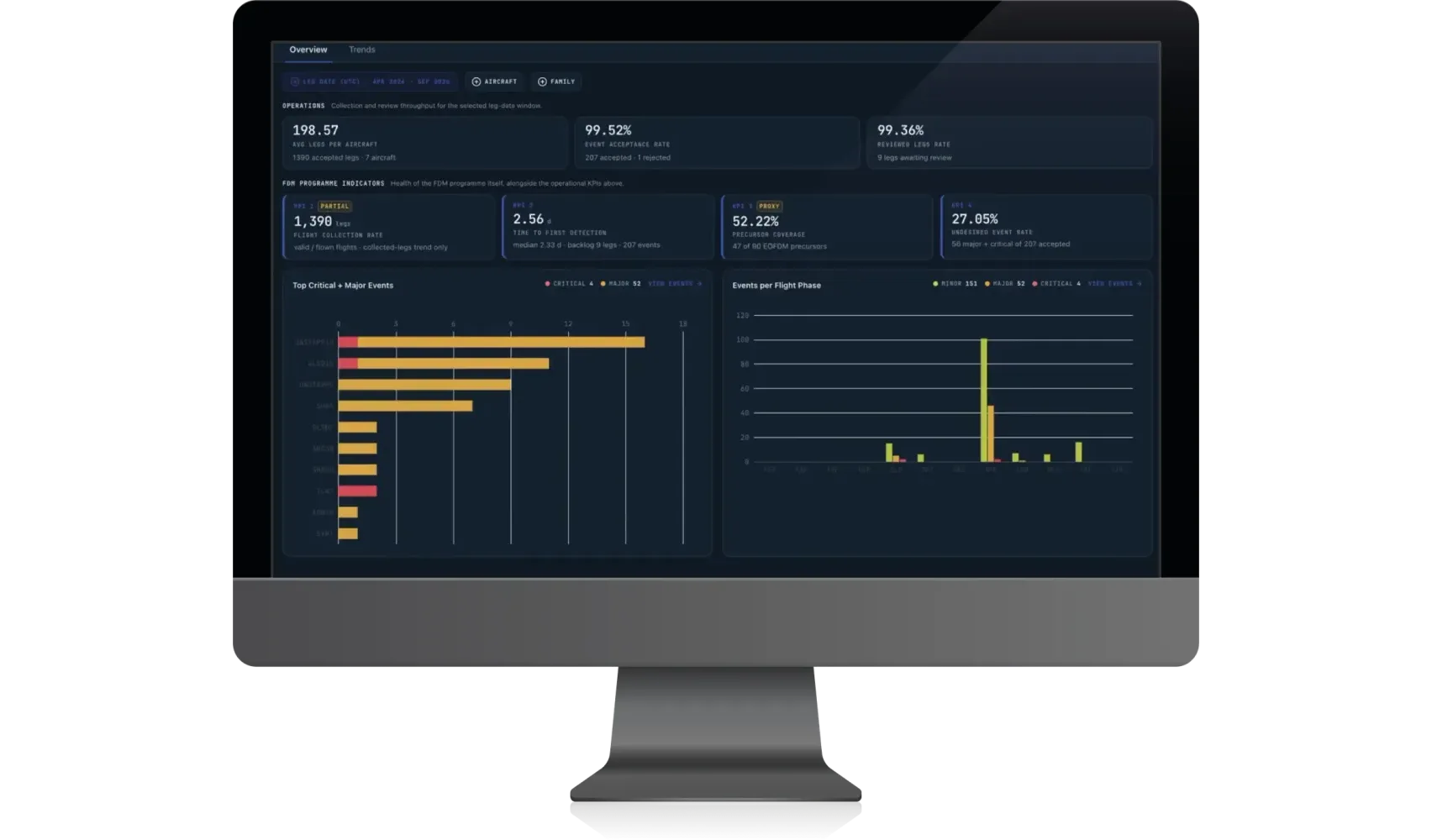
You do not assemble these in a spreadsheet the week before the audit; they are there the week after the audit too, which is the point.
Reports you build yourself
Every operator's reporting needs are different. The Accountable Manager wants one page a month. The safety review board wants the unstable-approach trend by airport. The Flight Data Analyst wants the same parameters across every occurrence of an event since the SOP changed.
AeroSight v2 includes a self-service report builder: choose the fleet, the period, the events and the measures you want to see, and produce the report yourself, when you need it, without raising a request with us and waiting. When the auditor asks for the same view, you build it in an afternoon, not a week.
Your Event Definition Sheet, with its history
The Event Definition Sheet (EDS), the events your programme monitors and the thresholds behind them, is the heart of a programme, and the thing an auditor wants to understand first. What does "unstable approach" mean in your operation? Who decided that? When did the threshold change, and what happened to the event rate afterwards?
In AeroSight v2 you can change your own EDS instead of raising a ticket with us. Each change is tested against your aircraft and can be reviewed and signed off by a second person before it takes effect, and every revision is kept. You can show an auditor what an event definition was on any date, who proposed the change and who approved it. That is the maker-checker discipline the ORO.AOC.130 AMC describes for the continuous review of an FDM programme, and the concurrence step FAA AC 120-82 expects of a FOQA program — built in, rather than reconstructed from email.
Who did what, and who can do it
Roles are defined by you, not by us. Define a Safety Manager, a Flight Data Analyst and an Accountable Manager, and each sees what that role needs and nothing more. Access is by invitation only; there is no self-signup.
Underneath, an audit trail records every governance action: who changed an event, who signed it off, who was granted access and who was removed. Entries cannot be edited or deleted, and you can export the trail for your own records or hand it to an auditor directly. Roles match the named access your information security policy requires, and the de-identification rules your FDM programme sets are left unchanged, which makes a just-culture policy easier to keep.
What this looks like during an audit
A competent-authority inspector working through ORO.AOC.130, or an auditor working through your safety management system (SMS), tends to want the same four things: evidence of coverage, evidence of timeliness, evidence of controlled event definitions, and evidence of who did what. AeroSight v2 keeps each of those on record, ready to show. The programme-health measures sit on the same safety overview your Safety Manager uses every morning.
The platform is built around the regulatory material — ICAO Annex 6, ORO.AOC.130, FAA AC 120-82, CAP 739 and the EOFDM guidance — and it supports your compliance rather than claiming it for you.
AeroSight, as an organization, holds ISO 9001:2015 and ISO 27001:2022 certifications.
It works at any scale, one aircraft or a hundred, and it stands on ten years of running FDM programmes, experience with 40+ aircraft types, and 40,000 flights processed a month.
See it on your data
Request a demo and we will walk you through the FDM programme-health view, the report builder and the sign-off history on a representative fleet, then talk through what your next audit is likely to ask for. If you are at the World Aviation Festival in Lisbon on 13–15 October, come and find us and we will do it in person. The video and the rest of v2 are on the AeroSight FDM v2 page.
Related Articles
Introducing AeroSight FDM v2 - what ten years taught us
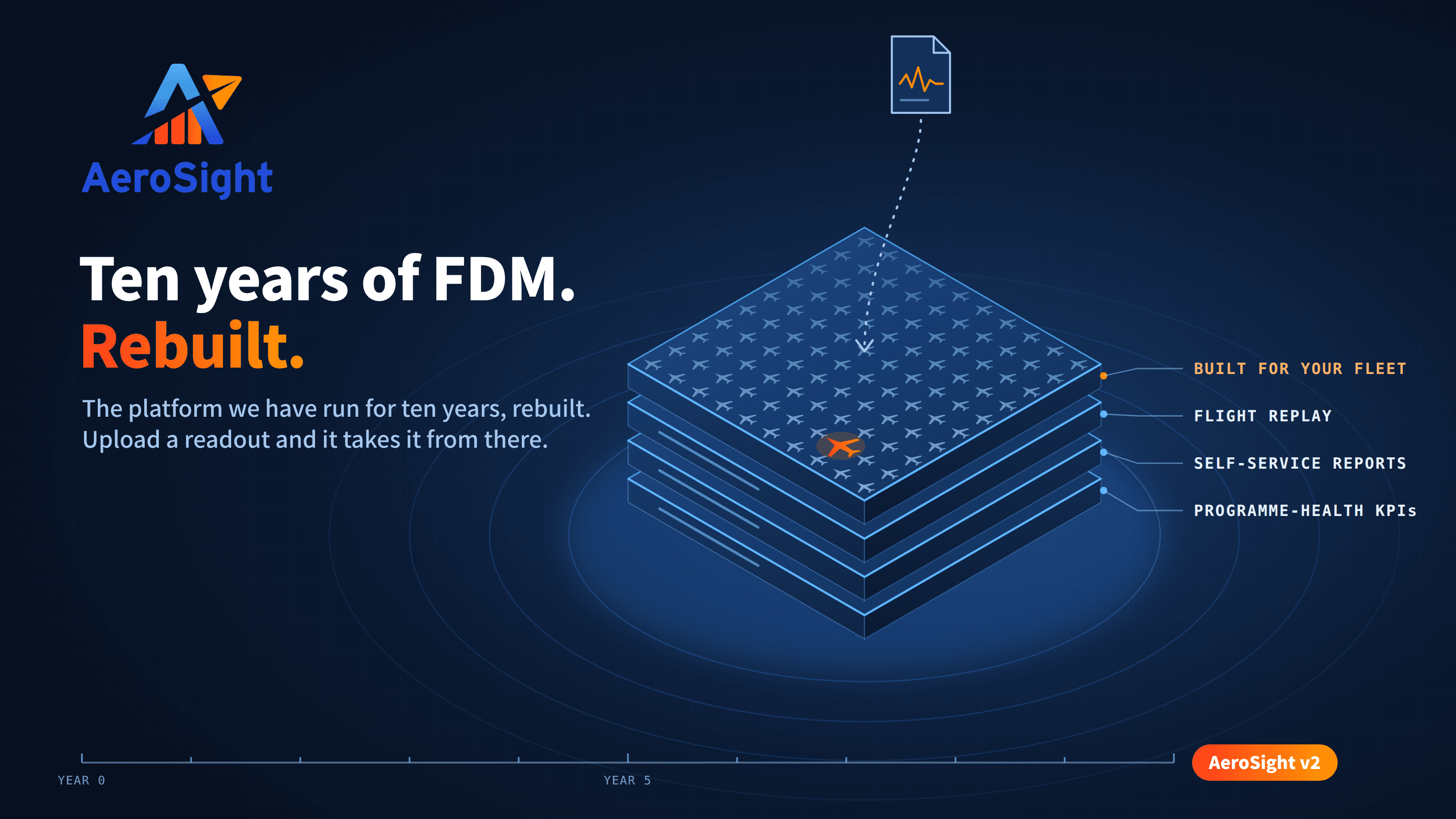
AeroSight FDM v2 is a rebuild of the platform we have run for ten years: every flight your fleet flies, event detection you tune yourself, programme-health KPIs, self-service reports, fuel efficiency and Live Fleet Monitoring, for one aircraft or a hundred.
AeroSight FDM v2 integrates with SafeJets in both directions
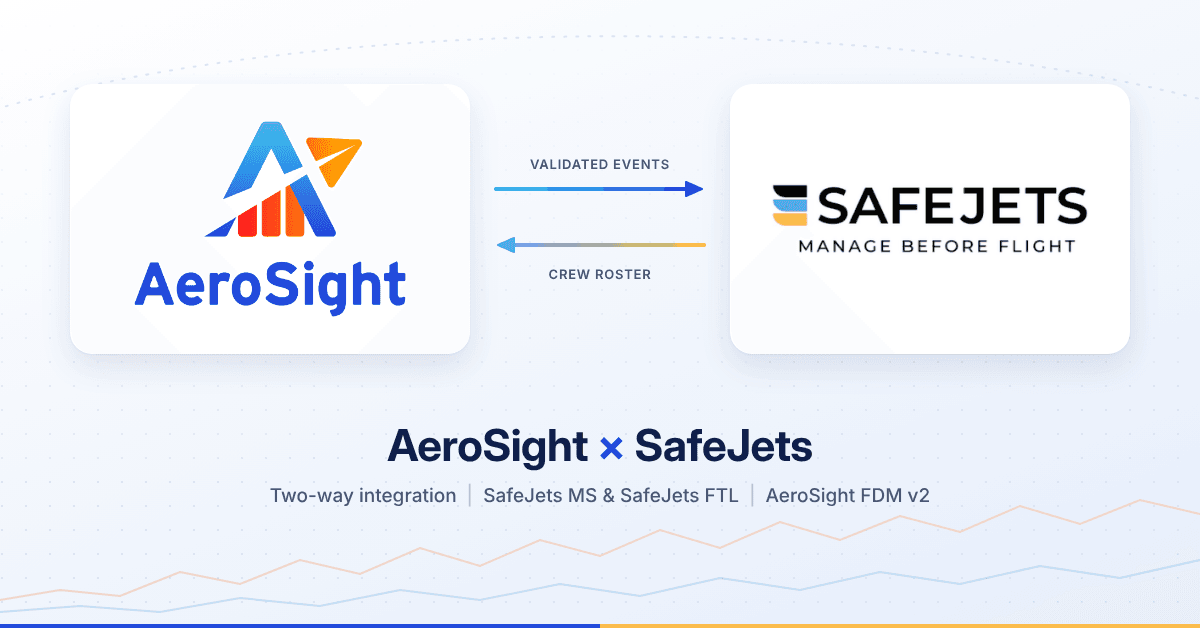
Accepted flight data events now flow straight into SafeJets MS, and crew assignment flows back from SafeJets FTL into pilot performance monitoring, so a finding reaches the people who act on it without anyone retyping it.