Introducing AeroSight FDM v2 - what ten years taught us
October 5, 2026 | Product
AeroSight Team
The new AeroSight platform, rebuilt after ten years of running FDM programmes: what changes for the Safety Manager, the Flight Data Analyst and the Accountable Manager, what it adds beyond the Safety department, what comes with you, and how to see it on your own data.
Today we are releasing the new AeroSight system. It is a rebuild of the flight data monitoring platform we have run for operators of every size for ten years, and it changes the working week of everyone who is involved in the Safety department: the Safety Manager, the Flight Data Analyst, and the Accountable Manager who is responsible for it.
Why we rebuilt it
Running FDM programmes for a single business jet, a regional airline, or a mixed helicopter and fixed-wing operation teaches you one thing above all: where the time goes. It is not the analysis part. It is in moving files, chasing a download that never arrived, checking a decode by hand, rebuilding the same monthly report, and taking days to answer a question from the Accountable Manager that should not need an analyst at all.
So we rebuilt AeroSight around a single idea. The programme should ask for your time only when a person's judgment is needed, and it should keep a record of what that person decided. Everything else should simply happen.
What changes for the Safety Manager
You see the flights your fleet flew, not only the ones that reached you. ADS-B flight history now sits beside your recorder data, so a flight that was flown but never uploaded shows up as a flight waiting for its data, not as a gap.
When a critical event is found, you hear about it in the app, by email or in the browser, and those emails never carry crew identity or raw parameter values. The decisions that need a person are gathered in one place, and each one is recorded, with who made it and when.
And the programme now measures itself. Programme-health KPIs aligned with EASA's EOFDM guidance sit on the safety overview: time from flight to first detection, data collection rate, event rates per hundred legs, and more. You can say, with numbers, how healthy the programme is, not only how many events fired.
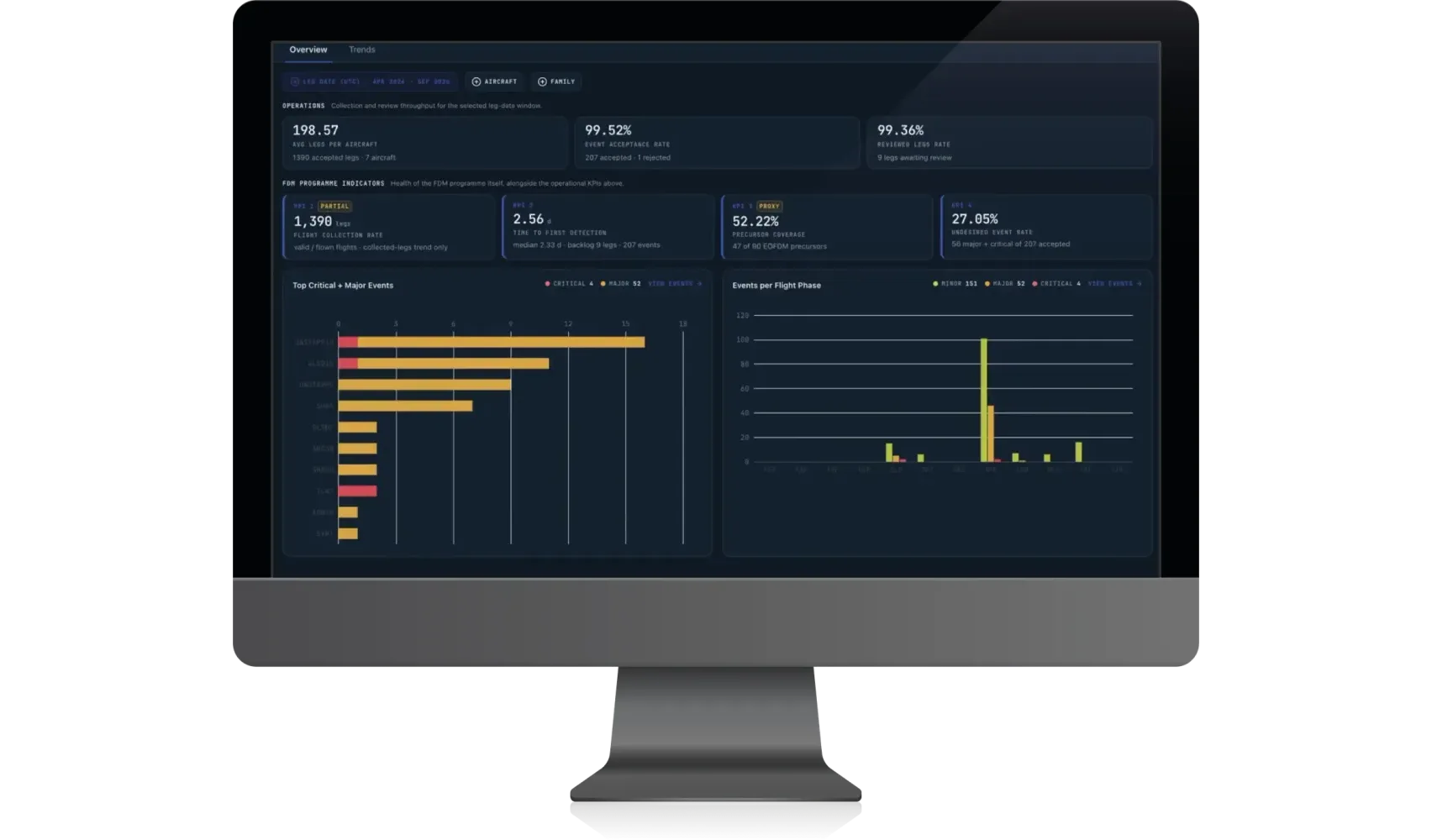
The result is a week spent on the safety picture rather than on the small tasks behind it. That holds whether you operate one aircraft or a hundred.
What changes for the Flight Data Analyst
The Event Definition Sheet (EDS) is yours to tune. Propose a change to an event or a threshold yourself instead of raising a ticket with us; it is tested against your aircraft and can be signed off by a second person before it takes effect, and every earlier version of the EDS stays on record.
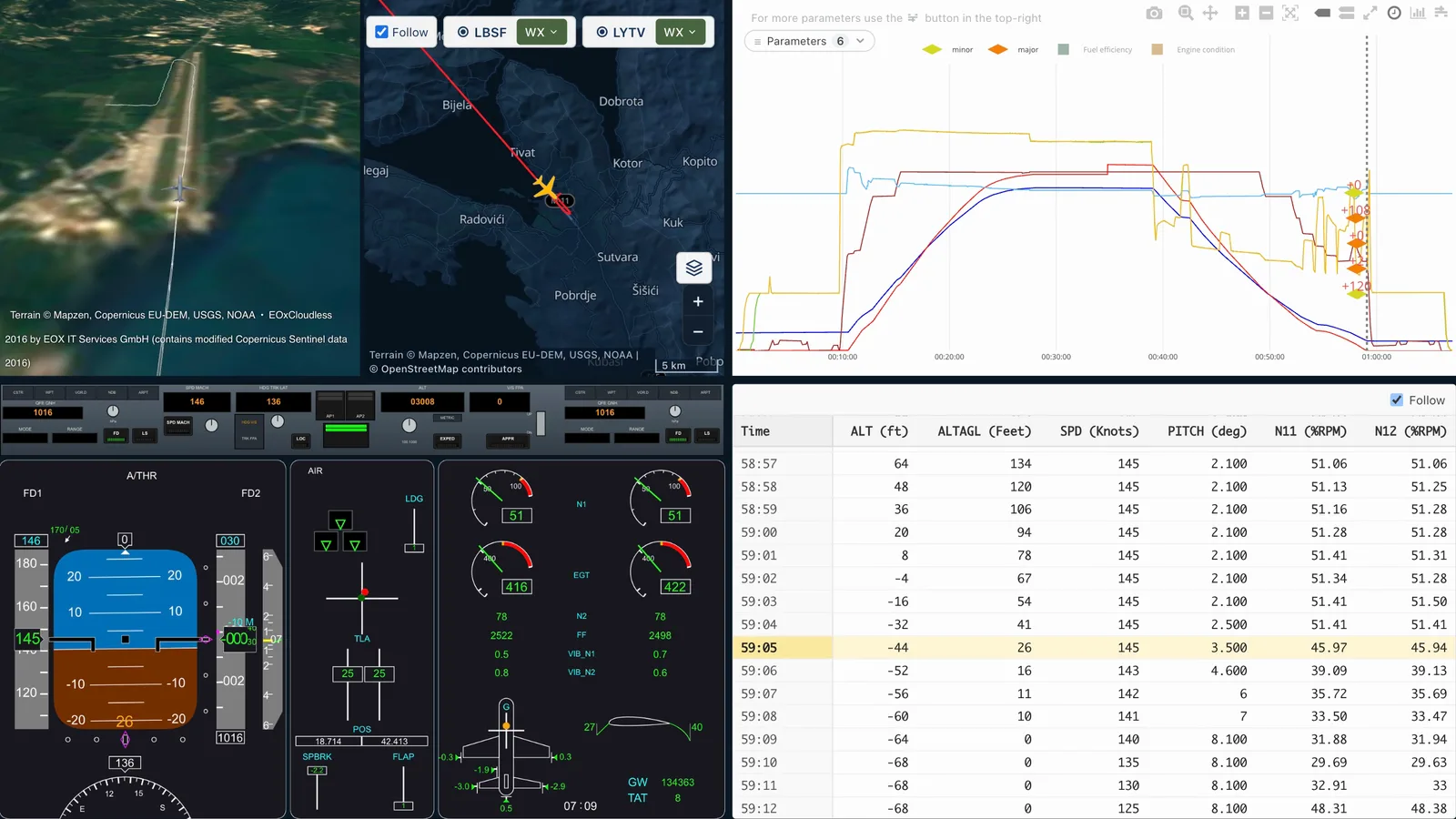
Weather data and navigational procedures are now connected throughout. The METAR around departure and arrival comes with every flight and with each of its events, and the published SIDs, STARs and approaches, from the AIRAC cycle in force on the day, are drawn beside the track that was actually flown; these procedures can also be shown on the live view of your fleet. You read an approach against its procedure and in the weather it was flown in, without opening another tool.
Build the report you need yourself, when you need it, and stop waiting on a vendor to produce it for you.
Replay stays at the center of it all: in 3D, on the map or from the cockpit view, with the parameters alongside, and an export to Google Earth when you need to show a flight to someone outside the safety office.
Imagery: EOxCloudless 2016 by EOX IT Services GmbH (contains modified Copernicus Sentinel data 2016), CC BY 4.0. Map data © OpenStreetMap contributors. Terrain: Mapzen terrain tiles. Produced using Copernicus data and information funded by the European Union — EU-DEM layers. SRTM and GMTED2010 data courtesy of the U.S. Geological Survey. ETOPO1: NOAA National Centers for Environmental Information.
What changes for the Accountable Manager
You can see real coverage: how many flights were flown, how many reached the programme, and which are still waiting for their data.
Every governance action is written to an audit trail you can export, so when an auditor asks who approved a change and when, the answer is already there.
Who sees what, who signs off on what and who administers the programme stay your decisions. Roles match the named access your information security policy requires, and the de-identification rules your FDM programme sets are left unchanged, which makes a just-culture policy easier to keep.
The design is built around ICAO Annex 6, EASA ORO.AOC.130 and its AMC/GM, FAA AC 120-82, and UK CAA CAP 739, so the platform supports your compliance rather than complicating it. Separately, AeroSight as an organization holds ISO 9001:2015 and ISO 27001:2022 certifications.
Beyond the Safety Office
AeroSight FDM v2 also reaches further than the safety department, and it is all one platform: the recorder data, the flight tracking, the weather, the published navigational procedures and, where your crew planning system is connected, the roster of who flew each flight.
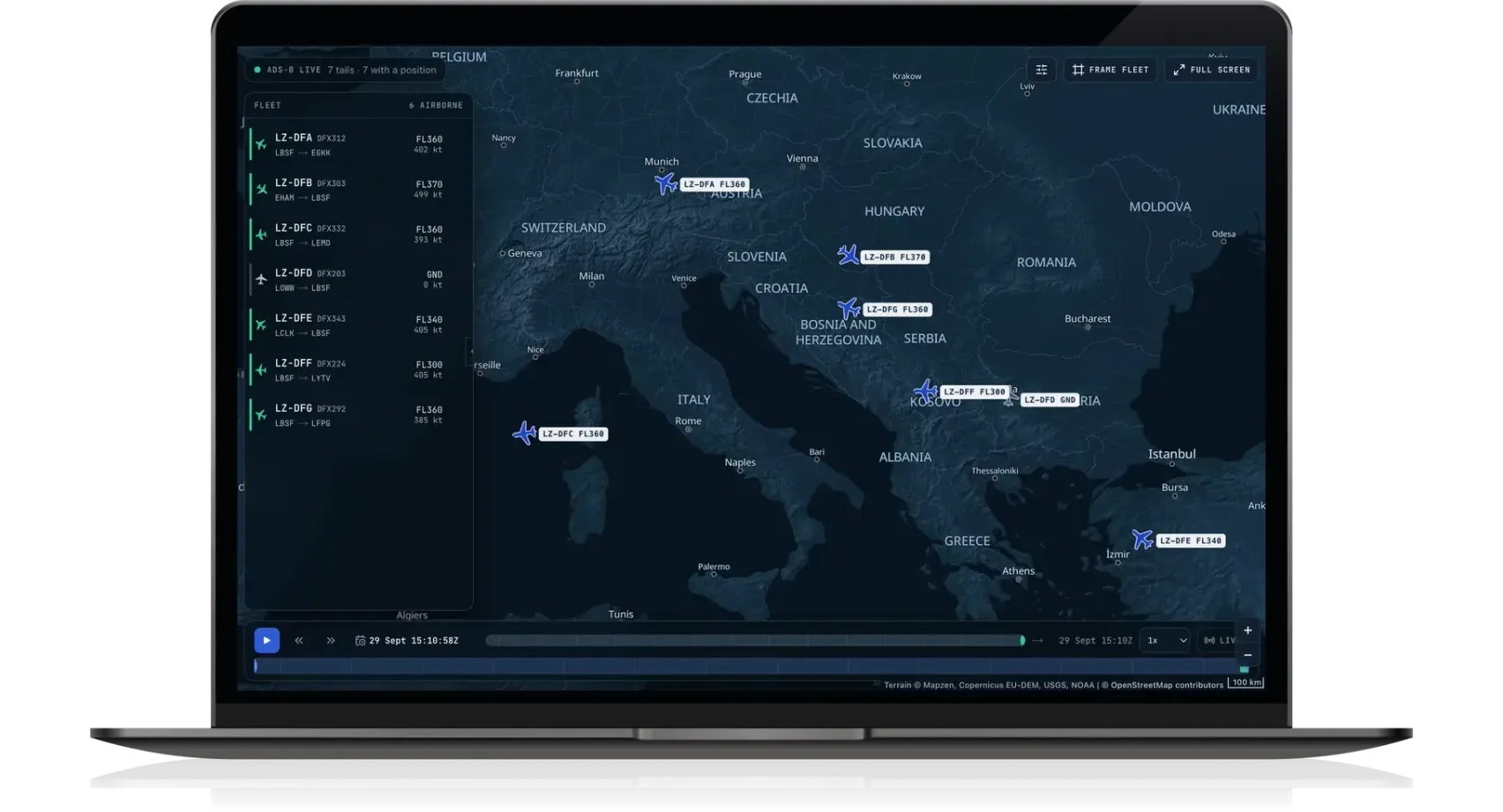
Live Fleet Monitoring is new, as an option: your fleet on a near-live map, each aircraft in flight or on the ground, with the current weather, runways and published procedures for the airports it flies to, and every flight one click from its flight view. More on fleet coverage.
Map data © OpenStreetMap contributors. Terrain: Mapzen terrain tiles. Produced using Copernicus data and information funded by the European Union — EU-DEM layers. SRTM and GMTED2010 data courtesy of the U.S. Geological Survey. ETOPO1: NOAA National Centers for Environmental Information.
Fuel Efficiency is a new module. It shows how often single-engine taxi is actually used across the fleet and the fuel still on the table, as an opportunity rather than a promised saving. It measures the other fuel-saving procedures flight by flight, and trends each aircraft's cruise performance against a baseline you choose. More on Fuel Efficiency.
Engine condition monitoring and Pilot Performance come with you, rebuilt so you can tailor them to your operation. Engine trends come from the data you already send, each engine is tracked as an LRU as it moves between aircraft, and the vendor exports are there for your engine programme. Pilot Performance shows each pilot's metrics: event rates, approach and overall ratings, and their most frequent events. A pilot given access signs in and sees their own performance, not a colleague's. More on engine condition monitoring and on Pilot Performance.
Built for the fleet you have
AeroSight FDM v2 reads data from various sources (FDR/QAR) and vendors: Honeywell, L3, Teledyne, Safran, Avionica, and generic ARINC 717 and ARINC 767 recorders. Aircraft types in service on the platform include the A320 and A330 families, B737CL/NG/MAX, B747, B757, B777, E195-E2, Bombardier Global, Gulfstream G700, Avro RJ, Beechcraft and many more, including helicopters, each set up for its own type of operation.
You do not need to bring a frame layout. Tell us your aircraft type and recorder configuration, and we build or reuse the layout for you.
Everything you rely on today comes with you
Upload raw data and the flights are automatically split, decoded and checked, with a parameter check report for each one, and their events detected, ready for your review, as they have been for ten years.
Your programme history moves with you, so trend lines are not restarted. Integrations with Leon Software, Avionica avSYNC and TrustFlight Centrik 5 carry over, and now SafeJets joins them.
Ten years of proof behind it
This is not a first release. It is built on experience with 40+ aircraft types and 100+ operators, on 40,000 flights processed a month and more than 1.5 million since 2016, and on ten years running programmes for operators around the world. The new platform is the shape that experience took.
How to see it
Nothing explains the new AeroSight like watching your own data go through it. Request a demo and we will walk you through the platform with your aircraft type. The video and an overview of the release are on the AeroSight FDM v2 page.
Over the next days we will publish a deeper look at the changes above: "Every flight your fleet flies", on fleet coverage and Live Fleet Monitoring; "See the flight, not the spreadsheet", on investigation; and "Your FDM programme's health, on the dashboard", on analytics and governance.
And if you are at the World Aviation Festival in Lisbon on 13 to 15 October, come and see it in person. The team will be at booth 2-139, and we would rather show you than tell you.